
A budgeting app that actually holds the money.
Most budgeting apps only watch money move and tell you after the fact. This one reserves real cash in per-item envelopes, then enforces it at the point of sale: money leaves your bank, sits in a funded envelope, and a virtual card only approves a charge if its envelope can cover it.
Tracking spending doesn't change it.
Traditional budgeting apps record transactions after they clear. By the time you see the overspend, the money is already gone. The app was a mirror, not a guardrail, so the numbers reset every month while the habits don't.
The goal here is discipline by design: reserve money into envelopes up front, spend through controlled rails, and let the system decline a charge an envelope can't cover before it happens, not after.
Key screens.
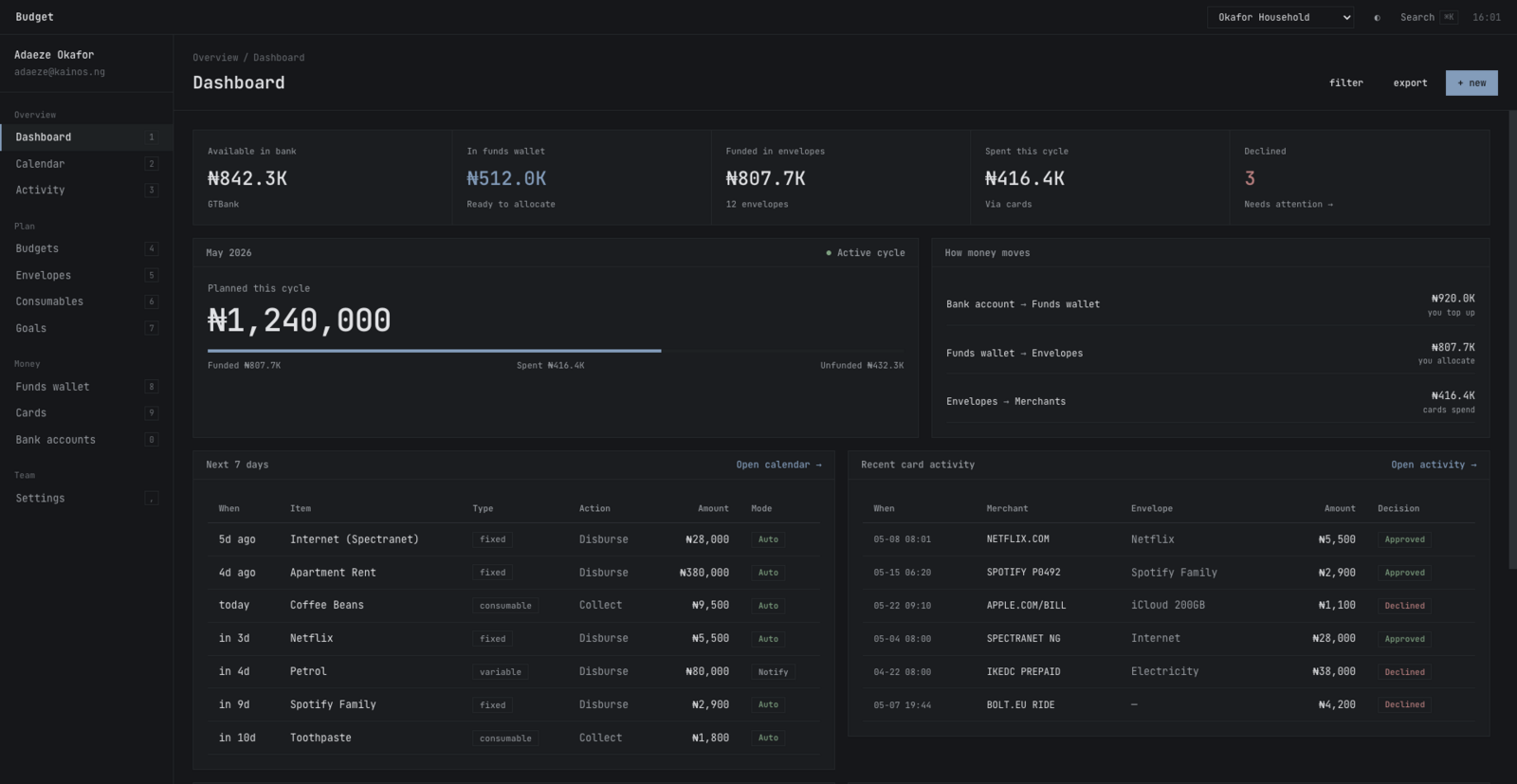
Dashboard
The whole system in one view: available in the linked bank, held in the funds wallet, funded across envelopes, spent this cycle, and how many charges were declined.
From bank account to approved charge.
Link the bank
Connect a primary account through Mono for verification and auto-debit.
Fund an envelope
Money actually leaves the account into a controlled settlement layer, reserved per item, not just tracked.
Balance updates
Each item, such as Spotify, Claude or Supabase, holds its own funded envelope balance.
Spend on a rail
Spending goes through a controlled rail: one virtual card per category, e.g. a Subscriptions Card.
Real-time authorization
On each charge the backend checks the item's envelope. Funded and valid approves; empty or invalid declines.
Settle and decrement
An approved charge subtracts its amount from the envelope balance instantly.
Discipline built into the rail.
Reserve before you spend
Funding an envelope moves real money, so budgeted and available are never the same number.
Enforced at checkout
A virtual card can only approve what its envelope covers. Discipline lives in the rail, not in willpower.
Map merchants to envelopes
Spotify to the Spotify envelope, Supabase to the Supabase envelope. Every recurring charge has a home.
See the whole picture
Available in bank, funded in envelopes, spent, upcoming and any declined charges, all in one glance.